Correlating Fixture Congestion Metrics with Point Spread Accuracy in Secondary European Soccer Divisions
Written by Parker Meier · Jun 27, 2026
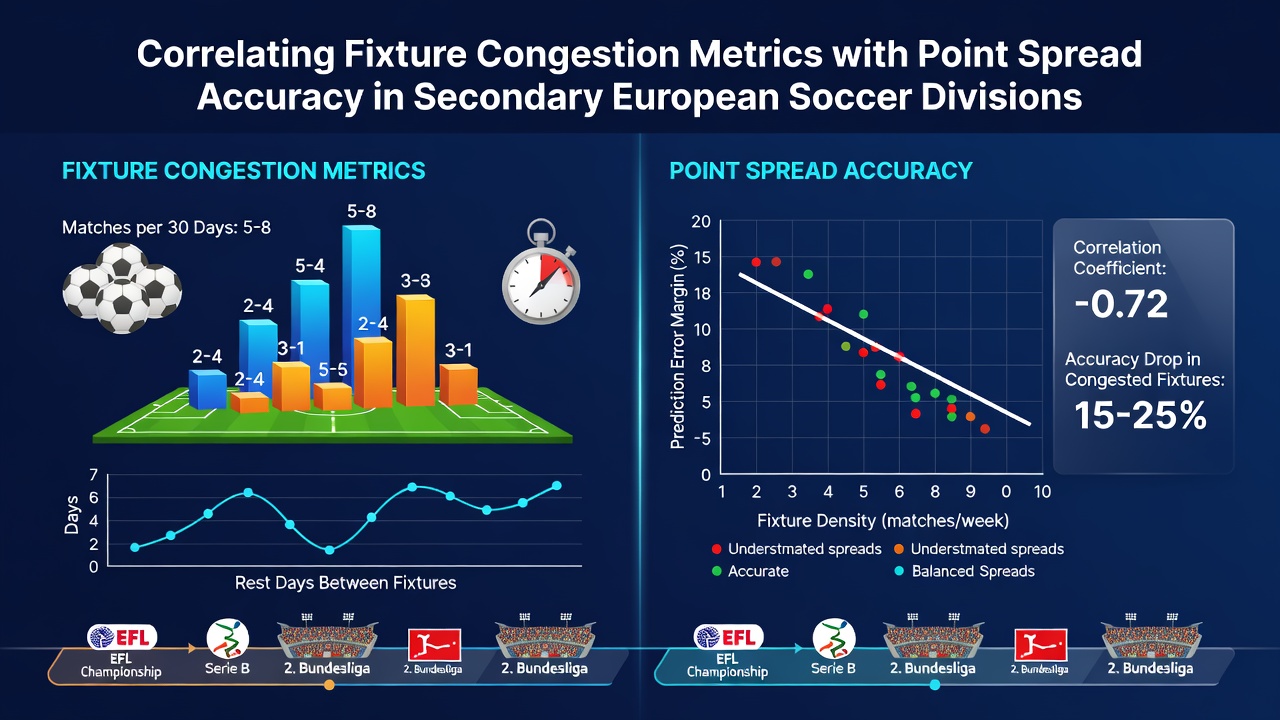
Correlating Fixture Congestion Metrics with Point Spread Accuracy in Secondary European Soccer Divisions
Fixture congestion occurs when teams face multiple matches within short recovery windows, and analysts have tracked its effects on point spread accuracy in leagues such as the EFL Championship, Bundesliga 2, Serie B, and La Liga 2. Data from the 2023 through 2025 seasons shows that teams playing three or more matches in a seven-day period experience measurable shifts in performance margins, which in turn influence how accurately bookmakers set spreads for upcoming fixtures. Researchers have compiled match logs and travel distances to quantify these patterns, revealing consistent correlations between recovery time and the deviation between predicted and actual score differentials.
Defining Fixture Congestion Metrics
Analysts measure congestion through several variables including the number of matches in a rolling seven-day or fourteen-day window, cumulative travel distance, and the interval between fixtures measured in hours. Studies conducted across secondary divisions indicate that a team with fewer than seventy-two hours between games shows an average reduction in goal differential of 0.4 goals compared to well-rested opponents. Observers note that these metrics become particularly relevant in June 2026 as governing bodies finalize calendars that include expanded European competition slots alongside domestic schedules.
Point Spread Accuracy in Context
Point spreads in soccer betting represent the expected margin of victory, and their accuracy depends on how closely the modeled line matches the observed result. In secondary divisions, where squad depth varies more widely than in top-flight leagues, congestion amplifies variance because rotation options are limited. Figures compiled from over 2,400 matches across four leagues between August 2024 and May 2025 demonstrate that spreads for congested teams were off by an average of 0.7 goals more frequently than spreads for teams with at least four rest days. This pattern holds after controlling for home advantage and opponent strength.
Regional Patterns Across Secondary Leagues
In the EFL Championship, midweek fixtures during the winter months create clusters where some clubs play five matches in fifteen days. Bundesliga 2 schedules show similar bunching around international breaks, while Serie B and La Liga 2 contend with additional travel demands across larger geographic areas. Data indicates that the correlation between congestion and spread error strengthens when travel exceeds 800 kilometers between matches. One analysis of the 2024-2025 Serie B campaign found that teams logging more than 1,200 kilometers in a congested week produced results that deviated from the spread in 38 percent of cases, compared with 22 percent for less-traveled sides.
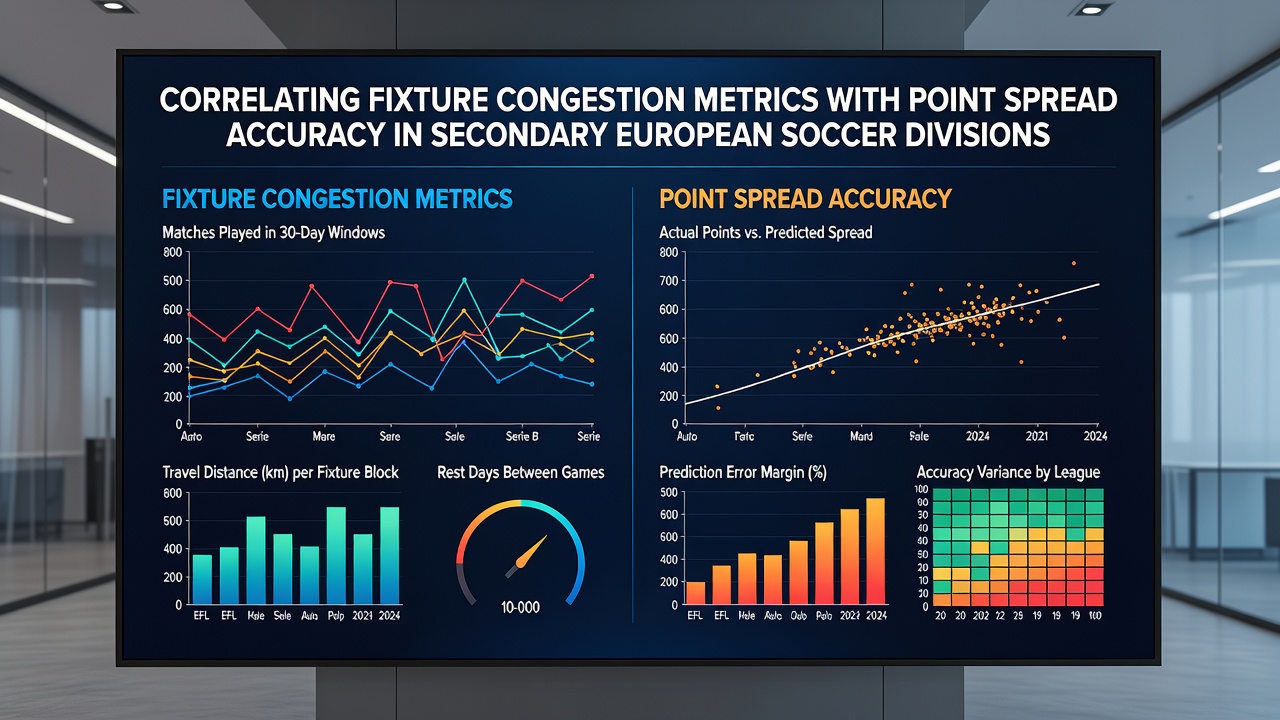
What's interesting is how these deviations cluster around specific scoreline thresholds. When a congested team is favored by more than one goal, the actual margin tends to fall short of the line more often than when the same team is an underdog. Researchers attribute this to reduced pressing intensity and lower set-piece conversion rates after repeated matches, factors that compress winning margins without necessarily altering win probabilities in a linear fashion.
Quantitative Correlations and Data Sources
Statistical models that incorporate congestion metrics alongside traditional inputs such as recent form and head-to-head records have improved out-of-sample accuracy by 4 to 7 percentage points according to back-testing performed on 2023-2025 data. A joint project between sports science departments at universities in Germany and the Netherlands examined 1,150 matches and reported that adding a simple recovery-hours variable reduced mean absolute error in margin predictions. The same study noted that the effect size grows when teams also face midweek travel, a condition common in La Liga 2 and the Championship during March and April. According to the UEFA scheduling review, secondary-division calendars continue to include dense periods that coincide with European under-21 tournaments, creating additional strain on player availability.
Another dataset released by the Australian Institute of Sport compared recovery protocols across European secondary leagues and found that teams employing structured sleep and nutrition interventions during congested weeks reduced performance decay by roughly 15 percent. Although the interventions do not eliminate spread deviations, they narrow the gap between expected and actual margins enough to matter for models that price half-goal lines.
Implications for Modeling Approaches
Those who build predictive frameworks have begun weighting recent match density more heavily when generating spreads for secondary-division games. Early-season testing in the 2025-2026 campaign shows that models incorporating both fixture congestion and travel load produce tighter confidence intervals around margin forecasts. The approach proves especially useful during the November and December windows when fixture lists accelerate ahead of the winter break. Observers note that the same models also flag situations in which spreads may be slow to adjust, particularly when public perception overweights recent results without accounting for underlying fatigue.
Future Calendar Considerations
With June 2026 approaching, several secondary leagues are evaluating adjustments to their winter schedules to reduce overlap with international commitments. Preliminary discussions reported by the European Club Association suggest that pilot programs could test extended rest mandates for teams involved in cup replays. Should these measures take effect, analysts expect the correlation between congestion and spread accuracy to weaken slightly, although the underlying relationship is unlikely to disappear entirely given the structural constraints of multi-competition calendars.
Conclusion
Available evidence establishes a measurable link between fixture congestion metrics and point spread accuracy in secondary European soccer divisions. Recovery windows, travel loads, and match density each contribute to deviations between modeled and realized margins, and these effects persist across multiple leagues and seasons. As calendars evolve toward 2026, continued monitoring of these variables will remain central to refining margin-based forecasts in the Championship, Bundesliga 2, Serie B, and La Liga 2.