Seasonal Adjustments in Resource Allocation for Multi-Event Forecasting Platforms
Written by Nils Franke · Jun 18, 2026

Seasonal Adjustments in Resource Allocation for Multi-Event Forecasting Platforms
Platforms that handle forecasts across multiple events must adapt their resources throughout the year because demand patterns shift with seasons, and these adjustments affect everything from computing power to personnel deployment. Research from the National Oceanic and Atmospheric Administration shows that seasonal cycles influence event volumes in weather, economic, and large-scale public gatherings, which in turn requires platforms to recalibrate server loads, data ingestion rates, and analytical teams.Core Drivers of Seasonal Demand Changes
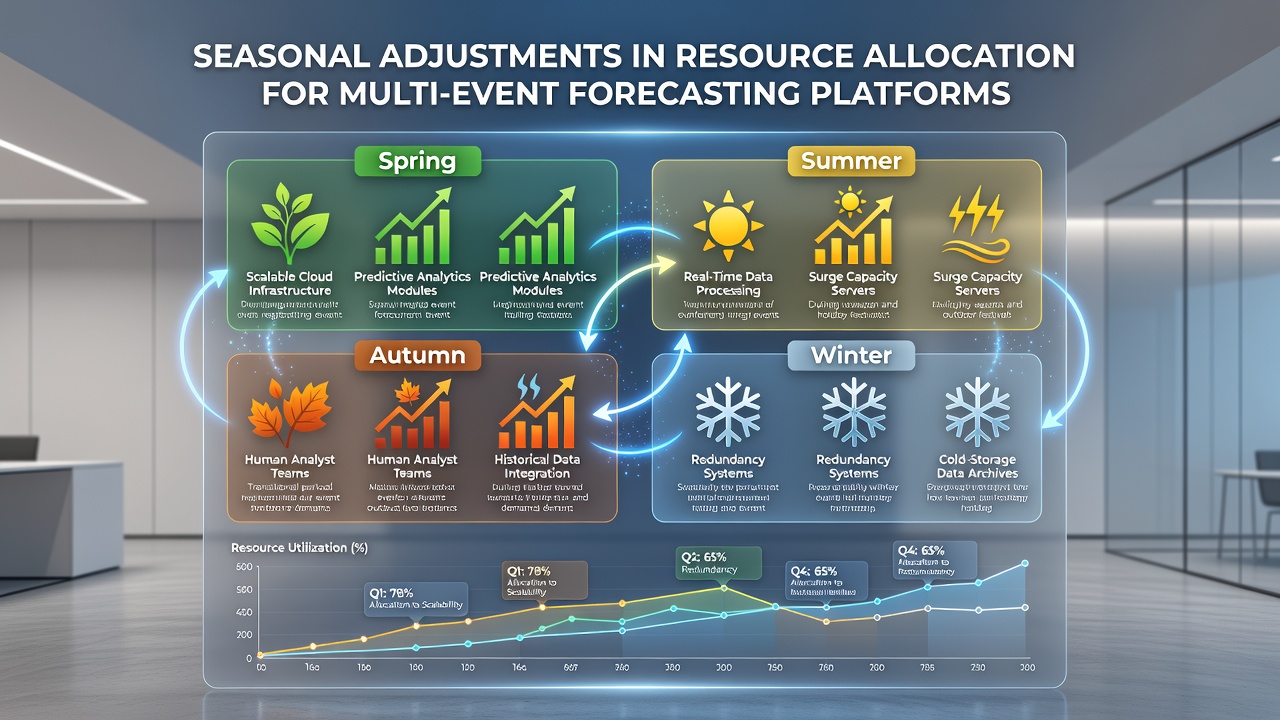
Multi-event forecasting systems process inputs from diverse sources such as satellite feeds, market indicators, and attendance records, yet the intensity of these inputs varies by month. In temperate regions, winter months generate spikes in meteorological data while summer brings surges tied to outdoor festivals and international tournaments. Observers note that platforms respond by shifting cloud computing allocations toward regions experiencing peak activity, and this redistribution prevents bottlenecks during high-volume periods.
According to data from the European Centre for Medium-Range Weather Forecasts, predictive models require additional processing nodes when multiple overlapping events coincide, such as concurrent regional elections and climate monitoring campaigns. Teams therefore pre-stage storage capacity and adjust algorithm priorities, allowing the system to maintain accuracy without over-provisioning during quieter intervals.
Allocation Techniques Across Calendar Cycles
Resource managers employ predictive scaling models that draw on historical usage logs to anticipate needs. These models incorporate variables like daylight hours, regional holidays, and recurring global events; for instance, platforms often increase GPU clusters in advance of the June 2026 international athletics calendar because concurrent competitions across continents drive simultaneous query volumes. The approach relies on automated scripts that migrate workloads between data centers located in different hemispheres, balancing thermal loads and electricity costs.
Staffing follows similar patterns, with analysts rotating between specialized teams focused on summer versus winter phenomena. Organizations maintain core teams year-round while contracting temporary experts during transition months, which keeps operational expenses aligned with actual forecasting demands rather than fixed annual budgets.
Technology Supporting Adaptive Systems
Modern platforms integrate container orchestration tools and machine learning schedulers that continuously evaluate incoming data streams. These tools detect early signals of seasonal acceleration, such as rising pollen counts that correlate with agricultural forecast requests, and automatically expand relevant microservices. Industry reports from the American Meteorological Society indicate that such automation reduces latency by reallocating idle resources within minutes rather than hours.
Geographic diversification of infrastructure plays a supporting role, because platforms hosted across North America, Europe, and the Asia-Pacific region can hand off tasks as daylight and event activity move westward each day. This handoff mechanism relies on standardized APIs that allow seamless data transfer while preserving model consistency across time zones.
Challenges in Maintaining Accuracy During Transitions
Transitions between seasons introduce edge cases where models trained on one set of conditions encounter unexpected variables from another. Platforms address this by running parallel validation suites that compare outputs from legacy and updated parameter sets. When discrepancies exceed thresholds, operators trigger targeted retraining cycles using fresh regional datasets, ensuring forecasts remain reliable even as underlying conditions evolve.
Regulatory frameworks in Canada and Australia further shape allocation decisions by imposing energy-efficiency requirements that vary with local climate seasons, prompting platforms to schedule intensive computations during cooler nighttime hours in each jurisdiction.
Looking Ahead to Mid-2026 and Beyond
With the approach of June 2026, planners anticipate heightened activity around multi-continental sporting and environmental monitoring events, which will test current allocation frameworks. Systems already incorporate forward-looking simulations that project resource curves based on scheduled calendars, allowing preemptive procurement of additional bandwidth and temporary colocation space. Continued refinement of these projections depends on feedback loops that compare forecasted versus actual loads from prior cycles.
Conclusion
Seasonal adjustments in resource allocation enable multi-event forecasting platforms to sustain performance across fluctuating demand landscapes. By combining historical analysis, automated scaling, and geographically distributed infrastructure, these systems maintain operational stability while responding to predictable calendar-driven changes. Ongoing developments in scheduling algorithms and cross-regional coordination will continue to shape how platforms prepare for periods such as the 2026 event cluster and subsequent cycles.